

Day: January 25, 2026
Artists Revisit Rokeya’s Vision in ‘Reimagining Sultana’s Dream’
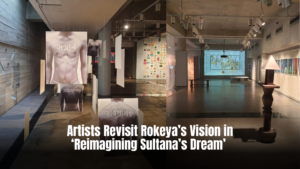
More than a century has passed after the legendary Begum Rokeya Sakhawat Hossain penned her iconic Sultana’s Dream (1905). To mark the 120th anniversary of the book—and its recognition in UNESCO’s Memory of the World (Asia-Pacific) register—the Liberation War Museum in Dhaka has launched Reimagining Sultana’s Dream, a group exhibition featuring works by twenty artists. The exhibition, neatly curated by Sharmille Rahman, is jointly organized by the Liberation War Museum and Kalakendra with support from Libraries Without Borders and Alliance Française de Dhaka and runs at the museum’s sixth-floor temporary gallery until March 7. Rokeya’s original narrative imagined a world where women govern society through reason, care, and scientific ingenuity, while men remain confined to domestic seclusion. The satire was sharp, the politics unmistakable: power, she argued, is not inherently masculine; it is merely monopolized. Yet, as visitors move through this exhibition’s sprawling installations, photographs, textiles, videos, and conceptual works, one realizes that the distance between Rokeya’s dream and contemporary reality remains narrower than it should be—and far more troubling than we might like to admit. The exhibition’s strength lies in its multiplicity of voices, and together, the artworks blur the boundary between literary homage and contemporary social critique. The artists visualized women’s invisible labor, persistent structural discrimination, and the resilience forged through everyday struggle. Many installations dwell on domesticity, wage inequality, bodily autonomy, and the silent endurance that sustains both households and economies. They do not romanticize womanhood; instead, they interrogate how patriarchy shapes aspiration, opportunity, and even imagination. For example, a striking, suspended photographic installation that features suspended images of men, where words such as “violence,” “wages,” “women’s labor,” and “possibility” are inscribed on their bodies. The images hang from the ceiling like a suspended interrogation. Are all these accusations aimed at men, women, or society at large? The artist framed the artwork as a question: “Perhaps you are the hunter, or the hunted.” This ambiguity implicates the audience to confront their position within systems of power. Another installation draws on Chakma weaving traditions—offering a reminder that alternative models of gender coexistence have long existed within South Asia’s indigenous cultures. The artwork gently counters the assumption that patriarchy is universal and immutable, proposing instead that social arrangements are historical choices—capable of being rewritten. Nearby, another artwork evokes the emotional terrain of women whose dreams remain pressed beneath social expectation, while another artwork centers working-class women, pairing video art with written testimonies that echo fatigue, hope, and perseverance. Rather than presenting women as abstract symbols, the piece insists on specificity—on listening closely to lived experience. Similarly, another installation uses repetition of sound to halt the visitor mid-step, demanding attention to voices often ignored. Collectively, all the artworks from the 20 artists reveal a paradox. While Sultana’s Dream envisioned a radical overturning of patriarchal norms, today’s artists find themselves still grappling with remarkably similar realities. The exhibition suggests that Rokeya’s satire was not merely ahead of its time—it remains unfinished business. But the show does more than just honor the feminist legacy; it questions its limits. Can art about women’s struggle transcend gallery walls and urban cultural circles? Or does it risk becoming another enclosed space where pain is aestheticized rather than transformed? In this exhibition, women’s voices, bodies, protests, and questions take on material form—etched in fabric, projected on walls, suspended in midair; it does not offer easy resolutions; instead, it insists that Rokeya’s dream must be reread, revised, and challenged continuously as an evolving dialogue. Ultimately, the exhibition reminds us that Begum Rokeya’s feminist utopia is not a destination but a process—one that requires vigilance, critique, and collective imagination. She dreamed of a world liberated from gendered injustice. So the exhibition asks a harder, more urgent question: are we any closer to living in it? Written by Shahbaz Nahian
Read More
Unseen Works of Kibria at Kalakendra
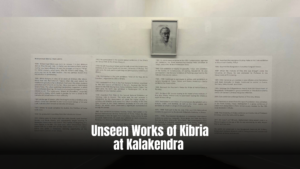
The lesser-known dimension of the late eminent artist Mohammad Kibria comes into view through a solo exhibition titled ‘An Artist’s Compilation: 84 Unseen Original Works (1980–2006)’, currently on display at Kalakendra, Dhaka. The exhibition presents 84 small-format works on paper, many of which are being exhibited publicly for the first time. Supported by City Bank, the exhibition is organized jointly by Kalakendra and the artist’s family to mark what would have been his 97th birth anniversary. The works in the exhibition are drawn from a handbound folio that Kibria himself compiled over more than two decades, suggesting a private archive shaped with care, discipline, and a quiet sense of purpose. What distinguishes this exhibition is the revelation of a more introspective Kibria. These pieces operate on an intimate scale. Most are created on letter-sized paper using pencils, pens, watercolors, pastels, etching, oil, mixed media, and collage. Printed paper fragments, clipped magazine pages, textured layers, and restrained color interventions are prevalent throughout. Several collages are composed of dark grounds—black, brown, or grey—onto which textured scraps and subtle tonal shifts have been assembled. In some places, small dabs of color punctuate the surface, while elsewhere, delicate linear gestures hover like afterthoughts. All these smaller-scale artworks emphasize restraint, nuance, and philosophical calm. Several compositions also evoke an archaeological sensibility—surfaces that appear weathered by time, such as fragments of ancient walls, corroded metal plates, or fading manuscripts. One particularly striking piece features a golden, matte texture that recalls eroded plaster, while another one features sharp white marks against a deep black field, resembling streaks of light piercing the darkness. Furthermore, the absence of individual titles reinforces the sense that these works were never meant to be spectacles. Instead, they function like notes, meditations, or private experiments—records of sustained inquiry rather than declarations intended for the market or gallery wall. Kibria himself selected and arranged these 84 works into a folio, binding them by hand and designing the cover. It remains unclear whether he intended to collect it for a future exhibition or publication. However, the artist’s particular focus on form, sequencing, and preservation is evident. Beyond the artworks themselves, the folio also contains personal materials—letters, exhibition catalogues, photographs, and even a drawing gifted by fellow artist, another legend, Kamrul Hassan. Also on view is a letter appointing Kibria as an emeritus professor at the University of Dhaka in 2008. Together, these artifacts frame the folio as a time capsule that traces both artistic evolution and lived history. Born on January 1st, 1929, in Birbhum (now in West Bengal, India), Mohammad Kibria graduated from the Calcutta Art College in 1950 before moving to Dhaka. He then joined the newly established Dhaka Art College in 1954. Later pursued advanced studies in Japan from 1959 to 1962 on a government-sponsored scholarship. Over the decades, he established himself as a master printmaker, painter, and educator, retiring from the Institute of Fine Arts at the University of Dhaka in 1987. He received major national honors, including the Ekushey Padak and the Independence Award, and remained a revered figure until his death on June 7, 2011. At a time when Kibria’s works have become increasingly scarce in public galleries, many now residing in private collections, this exhibition offers a rare opportunity to encounter a less visible chapter of his artistic journey. It reframes him as both a monumental modernist and a quiet chronicler of time, texture, and thought. In the midst of Dhaka’s urban intensity, Kibria’s folio opens a slower, more meditative world—one in which paper, pigment, and memory converse in subdued tones. The exhibition does not merely commemorate an artist’s legacy; it expands it, revealing a body of work that is at once archival, philosophical, and strikingly alive. The exhibition will run until February 2nd, 2026, open daily from 4 pm to 8 pm, with support from City Bank. Written by Shahbaz Nahian
Read More