
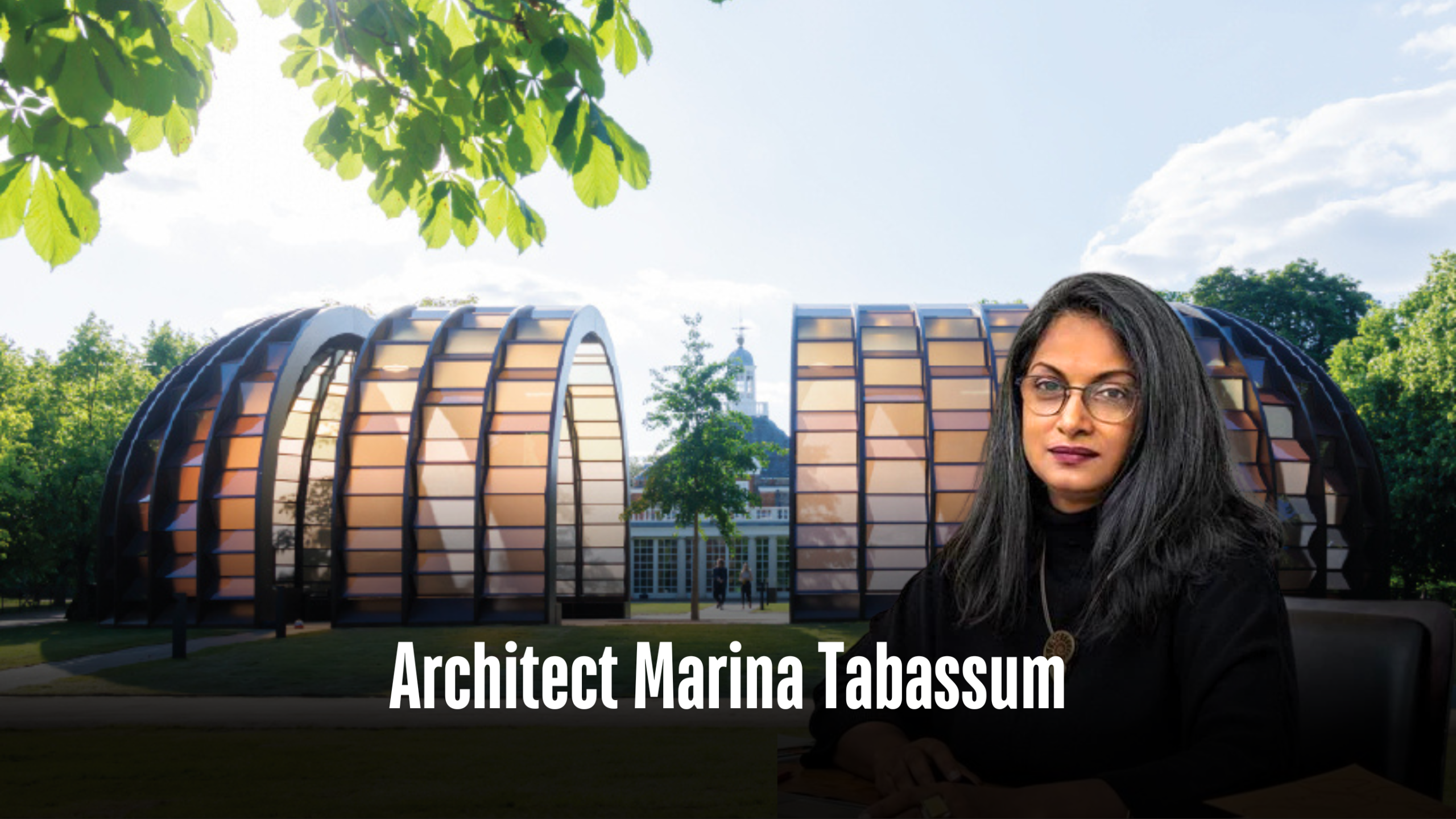

Architect Marina Tabassum has carved a luminous path that transcends architecture and redefined design as a language of place—rooted in climate, culture, and community.

Her Bait Ur Rouf Mosque, completed in 2012, became a global milestone when it earned the Aga Khan Award for Architecture in 2016. In 2025, she achieved the rare distinction of winning the Aga Khan Award again, this time for Khudi Bari.
Her brilliance extends far beyond these awards. Tabassum has designed the Museum of Independence, Panigram Eco Resort, Hamidur Rahman Memorial Complex, and Comfort Reverie, each reflecting her mastery of rhythm, sustainability, and memory. Internationally, she was commissioned to design the Serpentine Pavilion in London.
Marina studied architecture at the Bangladesh University of Engineering and Technology (BUET) and founded her own firm, Marina Tabassum Architects (MTA), in 2005. She has taught at renowned institutions worldwide: Professor at the Technical University of Delft (2022–23), Gerald Sheff Visiting Chair at the University of Toronto, and lecturer at the Harvard Graduate School of Design, University of Texas, Bengal Institute, and BRAC University.
Her work has earned numerous international accolades, including an honorary doctorate from the Technical University of Munich, the Arnold Brunner Memorial Prize from the American Academy of Arts and Letters, the Gold Medal from the French Academy of Architecture, and the Soane Medal in Architecture from the United Kingdom.
She chairs FACE (Foundation for Architecture and Community Equity) and Prakriti, a fair‑trade organization, and is a fellow of the Royal Society of Arts. Between 2017 and 2022, she served on the Steering Committee of the Aga Khan Award for Architecture.
Her accolades span continents: TIME 100 (2024), Chevalier of Arts and Letters (2023), UIA Vassilis Sgoutas Prize (2023), Jameel Prize (2018), and Prospect’s Top Ten Thinkers (2020).
Bait Ur Rouf Mosque

In the northern edge of Dhaka, beside the Turag Canal, the Bait Ur Rouf Mosque rises as a beacon of simplicity, spirituality, and environmental consciousness. Designed by Marina Tabassum in 2006, the project was deeply personal—commissioned by her grandmother, who donated the land.
The mosque rejects ornamentation, instead embracing perforated brickwork that allows natural light and ventilation to animate the prayer hall. This environmentally friendly approach is rare in Bangladesh, where mosques often rely on artificial cooling and lighting.
Here, light itself becomes the architecture—shifting with the hours of prayer, creating atmospheres of contemplation and serenity.
Tabassum’s design responds to both urban transformation and community needs. As Dhaka’s sprawl consumed open spaces, she envisioned the mosque as more than a place of worship: a plinth and gathering space for dialogue, reflection, and social interaction.
Rooted in Islamic tradition, where mosques historically served multiple civic functions, the building reclaims that identity for modern times.
The prayer hall, rotated to align with the qibla, is supported by eight columns and wrapped in load‑bearing brickwork, balancing cost efficiency with timeless strength.
Awarded the Aga Khan Award for Architecture in 2016, Bait Ur Rouf Mosque stands as a model of climate‑responsive, community‑driven design—an enduring testament to the power of light, space, and faith.
Khudi Bari

In Bangladesh’s fragile deltaic landscape, where rivers shift and floods displace thousands, Marina Tabassum envisioned Khudi Bari—a self‑initiated experiment that has grown into a global model of resilience.
Meaning “small house,” the lightweight, modular shelter is built from bamboo and corrugated metal, designed to be assembled quickly, relocated easily, and withstand the pressures of a volatile climate.

What began as a modest idea has transformed lives across chars, floodplains, and refugee camps. Families who once lost everything to river erosion now remain together during disasters, a safeguard against child marriage and trafficking. In Rangpur, when surrounding homes collapsed in a storm, Khudi Bari units stood firm.

The design’s impact extends beyond Bangladesh. The Vitra Design Museum in Germany acquired a Khudi Bari for its permanent collection, while the World Food Programme commissioned Tabassum to adapt the system for Rohingya refugee camps in Cox’s Bazar.
There, Khudi Bari evolved into women‑friendly community centres, food distribution outlets, and “Shantikhana” or Houses of Peace—spaces for education, livelihood, and healing.
Awarded the Aga Khan Award for Architecture in 2025, Khudi Bari is more than shelter. It is architecture as empathy—an elegant, low‑cost structure that restores dignity, strengthens communities, and redefines how design can serve humanity.

To honour the brilliance and achievements of Architect Marina Tabassum, Ceramic Bangladesh Magazine, a publication of the Bangladesh Ceramic Manufacturers and Exporters Association (BCMEA), in partnership with ArchiConnect—the first and largest digital platform for architects and professionals in the construction industry in Bangladesh—organised a grand event at the Renaissance Dhaka Gulshan Hotel on November 8.
Architect Moushumi Ahmed moderated the beautifully crafted night, attended by the country’s leading architects, real estate and construction industry leaders, and media personnel.
In his opening remarks, Architect Jalal Ahmed, FIAAB, KIA, founder and CEO of ArchiConnect, said: “Winning the Aga Khan Award for Architecture—often referred to as the ‘Oscar of architecture’—was no accident. It is the result of her deep thinking, clarity of perspective, and unwavering ethical commitment.”
PANEL DISCUSSION

The grand event had a panel discussion featuring the country’s top architectural minds.
Architect Mahmudul Anwar Riyaad, principal designer and director of DWM4 Architects, moderated the session, opening with the question of how the Aga Khan Awards had affected architects during the 1980s.
Architect Fuad Hassan Mallick, professor and dean of the School of Architecture and Design at BRAC University, recalled the surprise of the first award cycle: “I personally felt that architecture’s spectrum is much larger than what we understood—and also it seemed relevant for our country. This sort of thing ended up being number one for many of us. After that, when Mimar magazine appeared, we understood architecture is not only Western, American, and Europe‑centric. Something is there in our region also.”
Architect Nahas Ahmed Khalil, principal designer of ARC Architectural Consultants, praised the honesty in Marina’s design of Khudi Bari.
“I knew you (Marina Tabassum) from the start. Saw that from early you were serious, never compromising,” said Architect Prof. Zainab Faruqui Ali, chairperson of the Department of Architecture, BRAC University. “I feel that at the stage you are now, you are an iconic figure for the next generation. Your global experience we can tap.”
At the end of the discussion, Marina shed light on what kind of structures Bangladesh currently needs for marginalized people, emphasizing that such efforts require strong policy support.
The main attraction of the night, Architect Marina Tabassum, then delivered a detailed keynote speech on the projects that won her global acclaim and those she loved working on.
Marina began by highlighting the legacy of Islamic architecture, the Aga Khan Award, and the significance of winning it twice.
“This was a very personal project for me. Because my grandmother commissioned it. She donated her own piece of land,” she said about the award‑winning Bait Ur Rouf Mosque.
“My budget for the mosque was very low. So, if I can get light freely, that’s what I used most. Basically, the sense of spirituality, the use of light and not revealing the source—when the source of light is not revealed but it comes into illuminating space—that to me becomes spiritual,” she explained while showing project details through images.
She then presented the famous Khudi Bari, a bamboo‑built house capable of handling floods thanks to its mobile and easy‑to‑assemble nature.

“Each of these projects began through community gatherings—sitting with refugee women to ask them directly what they needed. Because neither I, nor even the UN or WFP officials, could truly know their needs without listening,” she said.
SERPENTINE PAVILION

Marina Tabassum’s journey from Dhaka to the world stage reached another milestone in 2025 with her commission for London’s Serpentine Pavilion. This project carried her philosophy of architecture as memory, community, and resilience into an international arena.
Drawing from her own cultural experiences, Marina reimagined the pavilion as a shamiana, the fabric canopies of South Asian gatherings. Built with glulam timber and steel frames, wrapped in polycarbonate layered with colour, the structure filtered light into a warm, communal glow.
At its centre stood a ginkgo tree, symbolizing endurance and renewal, aligning the pavilion with the Serpentine Gallery’s bell tower to create a powerful axis between landscape and structure.

Though temporary, the pavilion became a capsule of shared experiences. Tabassum envisions its rebirth in Doha as a library—“Book of Knowledge”—transforming a fleeting installation into a lasting space for learning.
CONCLUDING CEREMONY
At the concluding ceremony, BCMEA President Moynul Islam and ArchiConnect Founder and CEO Architect Jalal Ahmed honoured the panel discussants with Muzharul Islam 1923–2012: A Portfolio of Built Work, a landmark publication showcasing the projects of Muzharul Islam, the pioneer of modern architecture in Bangladesh.

BCMEA and ArchiConnect also recognised Artist Anisuzzaman Anis, Professor at the Department of Printmaking, Faculty of Fine Art, University of Dhaka, with the folio.
At the same time, Abdul Hakim (Sumon), senior vice president of BCMEA and managing director of Excellent Tiles, was honoured with the publication as a young entrepreneur.
A special creation by Artist and Professor Anisuzzaman Anis was then presented to Architect Marina Tabassum, as well as to BCMEA President Moynul Islam and ArchiConnect CEO Jalal Ahmed.

The evening concluded with closing remarks from the BCMEA President: “The Khudi Bari project of Marina Tabassum is timely and relevant in the context of Bangladesh. I come from the Padma riverbank, from Harirampur, where river erosion is a constant reality. For people there, such solutions are essential.”
He added: “In my business career, I have often worked with architects. Whenever a structure is built, their guidance is indispensable. Architects, with their refined minds and creative vision, bring beauty to our built environment. I urge them to continue creating for us—we will see, and we will manufacture.”
Written by Shoyeb Rehaan