

Made in Bangladesh
FIERO’s Custom Clothing and Changing Urban Rituals in Bangladesh
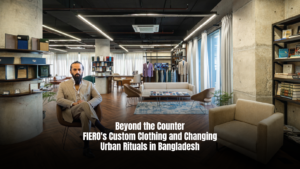
What began as a modest idea in mid-2017—to provide home-service tailoring for people constrained by time—has, within eight and a half years, evolved into FIERO, a leading bespoke and made-to-measure clothing practice in Bangladesh. Rooted in Dhaka yet informed by global traditions of craftsmanship, FIERO reflects a quiet shift in how custom clothing is conceived, experienced, and delivered in the local context. To understand this shift, it is necessary to look back at the tailoring culture that shaped earlier generations. For decades, the ritual was familiar: men accompanying their fathers or uncles to fabric stores overflowing with rolls of cloth in every imaginable colour and quality—good, bad, and everything in between. One would select a fabric, have it cut, leave measurements behind, and depart. The process was largely transactional, often hurried, and rarely comfortable. Instead of functioning like a conventional store, the tailoring journey is reimagined as something closer to being hosted in a living room. Guests are encouraged to slow down, sit comfortably with a cup of tea, and engage in unhurried conversation about what they wish to make. Founder and Managing Partner Syed Easir Alam (Yasir) explains that this sense of hospitality is intentional. “We welcome our guests with tea when they enter. Then we sit together and discuss fabric options. Our store is not a display centre of fabrics,” he says. With globalisation and changing lifestyles, bespoke clothing gradually became repositioned as a more exclusive, almost privileged service. Yet demand persisted across social strata—from lower-middle to upper segments—particularly among professionals, corporate executives, and business leaders for whom clothing remains closely tied to identity and confidence. FIERO emerged at this intersection of inherited practice and contemporary expectation. While a few brands in Bangladesh now offer bespoke services, FIERO’s approach centres less on retail and more on process. Rather than racks and shelves, fabrics are curated through carefully organised swatch books. Sourced from different parts of the world, these materials offer a range of quality and variety rarely available locally. Today, the collection includes more than 10,000 fabric options. Displaying such a volume physically would be impractical, but through swatches, clients can compare textures, weights, and finishes—many of them high-end, super-fine fabrics not commonly found in Bangladesh. This working method directly influenced the spatial decisions behind FIERO’s flagship space on Gulshan Avenue. The previous location, less than half the size, was inadequate for hosting multiple guests comfortably. The new space was conceived not merely as a store, but as a place where time could be spent without pressure. Guests may book appointments or walk in, settle into the space, and look out over the city. The intention is clear: no rushing, no crowding—only a calm environment that feels closer to home than to retail. Once fabrics are selected, measurements are taken by an in-house tailor to maintain consistency and quality. Design decisions follow, guided by a comprehensive catalogue that brings together options across categories—from trousers and jackets to full suits. Rather than prescribing styles, the process encourages clients to participate actively, choosing details that align with their needs and lifestyles. The interior design reinforces this approach. “We needed a place that felt like home—spacious and breathable,” says Alam. The layout prioritises openness, uninterrupted sightlines, and abundant daylight. Visual connections between inside and outside are maintained, allowing the city to remain a constant backdrop. A small book corner acknowledges FIERO’s largely educated and corporate clientele, for whom reading and reflection are familiar parts of daily life. In an era when people are increasingly particular—even about sleepwear—custom clothing demands attention to detail and emotional comfort. FIERO recognises that good decisions are made in good moods, and that environment plays a crucial role in the making process. Designed by Kaleek Consultants, the interior balances functionality with warmth: a continuous open space, multiple lounge-like seating areas, fitting rooms, tailoring zones, and work areas, all unified by light, views, and calm. FIERO’s story is not only about clothing. It is about rethinking bespoke tailoring in Bangladesh as a process shaped by time, comfort, and thoughtful design as much as by craftsmanship—offering a grounded example of what “Made in Bangladesh” can signify today. Written By Sadia Tarannum
Read More
MADE IN BANGLADESH: Homegrown Champions of Change
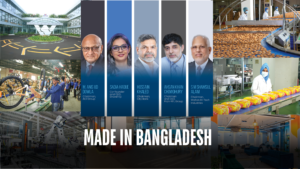
Bangladesh’s meteoric rise in the global garment industry has long been admired, and now a deeper transformation is underway — one that reflects diversification, resilience, and ambition. Amid global supply chain realignments and rising manufacturing costs in East Asia, Bangladesh has emerged as one of the world’s most export-ready economies. But beyond the looms and threads, “Made in Bangladesh” businesses are stepping into the spotlight — from green technology and agribusiness to pharmaceuticals and consumer goods. It’s time the world pays closer attention to the homegrown brands proudly carrying the “Made in Bangladesh” label. The list is far from exhaustive, as Bangladesh is home to many more brands that deserve global recognition. In this special feature, we bring into focus five companies and visionaries who have not only grown with the country but have also redefined what it means to be a “Made in Bangladesh” business. From expanding beyond borders to competing with international players, their journeys reflect the spirit of a nation that refuses to be boxed in. A common thread binds them all — a relentless desire to rise despite the odds. To begin the story, there is none other than Anis Ud Dowla, the visionary chairman of ACI Group. A pioneer in every sense, Dowla represents the kind of leadership that has helped redefine the possibilities of Bangladeshi enterprise. Next comes Hossain Khaled, Chairman of City Bank. This visionary banker played a crucial role in transforming a struggling bank with weak financials into one of the top lenders in the country. From the travel and tourism field, Sadia Haque — co-founder and CEO of ShareTrip — steals the spotlight with her innovations in the sector. The full-stack travel solutions her firm offers have brought about a massive change in the tourism landscape of Bangladesh. No story on Bangladesh would be complete without mentioning Ahsan Khan Chowdhury, chairman and CEO of Pran-RFL Group — a perfect example of how a legacy can be nurtured and turned into an empire. And last but not least, Walton Hi-Tech Industries PLC — the first Bangladesh-origin company to ship electrical and electronic appliances to international markets — stands as a testament to the nation’s growing industrial prowess. Let’s explore the trailblazers behind the “Made in Bangladesh” renaissance. A Beacon of Principled Leadership In Bangladesh’s corporate history, few names command as much respect as M. Anis Ud Dowla. At a time when business and politics often converge, Dowla has carved a distinct path—one rooted in ethics, innovation, and an unwavering commitment to national progress. His career began not in boardrooms but in the field, as a young executive with British Oxygen. Over nearly three decades, he rose through the ranks, managing operations across Pakistan, Kenya, and Bangladesh. That global exposure laid the foundation for a leadership style defined by experimentation and efficiency. The defining moment came in 1992, when Imperial Chemical Industries (ICI) offered him a chance to take over its Bangladesh operations. The deal was unconventional: a “pay-as-you-earn” arrangement that required no upfront capital. Dowla accepted, and Advanced Chemical Industries (ACI) was born. “The beginning was challenging, but I made sure that no matter what, I would remain fair to my workers,” Dowla said. “I assured them that they would receive a fair share of the benefits for the efforts they were putting in. It was a 60:40 profit-sharing arrangement between the investors and workers. And it paid off.” From modest beginnings with just 352 employees, ACI has grown into one of the country’s largest conglomerates, now employing over 30,000 people across 29 subsidiaries. Its portfolio spans pharmaceuticals, consumer goods, agribusiness, and logistics. Under Dowla’s leadership, ACI became the first Bangladeshi company to earn ISO 9001 certification, setting a benchmark for quality and transparency. “I wanted to have a guardian who would ensure that there was no compromise in quality. The ISO certificate did that for me. They used to visit ACI, conduct audits, and help me produce quality products every time.” “I went for the certificate to fulfil my dream of remaining true to our customers and never deceiving anyone in any way.” Despite his success, Dowla remains grounded. His philosophy centres on values—quality, fairness, customer focus, and continuous improvement. These principles, he insists, are not slogans but lived realities within the company. Dowla’s views on politics are equally clear-cut. He believes that mixing business with political ambition undermines merit and compromises governance. “I strongly believe entrepreneurs should not enter politics, and politicians should not be entrepreneurs.” For Dowla, politics is a service, not a career path for entrepreneurs. At ACI, employees are treated as family. The ACI chairman sees leadership as a process of unlocking human potential. To young entrepreneurs, his advice is simple yet profound: pursue what you love, embrace failure as a lesson, and never settle for shortcuts. Even in his late eighties, Dowla remains active, drawing energy from ideas rather than rest. In an era of blurred boundaries and shifting values, Anis Ud Dowla stands as a beacon of principled leadership—an icon admired not just for what he built, but for how he built it. From Startup to Market Leader When Sadia Haque set out to build a travel platform, her vision was rooted in something deeper than bookings and itineraries. “We wanted a travel tech platform where everything would be shared,” said the ShareTrip CEO and Co-Founder. “Sharing of adventure, sharing of experience, sharing of laughter, and sharing of joy. And from that perspective, the name came as ShareTrip.” That philosophy of connection would go on to shape one of Bangladesh’s most successful digital ventures. Drawing on her background in telecoms, media, and technology, Haque channelled over a decade of corporate experience into a startup that would soon redefine how the country travels.
Read More