

Day: January 30, 2026
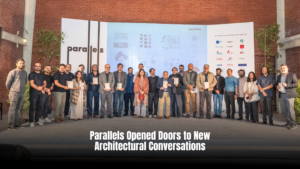
Parallels Opened Doors to New Architectural Conversations
Parallels, a group exhibition by eight architectural practices, concluded on a positive note, drawing strong visitor engagement and thoughtful conversations throughout its run. Conceived as a platform for inquiry and dialogue rather than definitive answers, the exhibition encouraged reflection on architecture’s broader cultural and social role. The exhibition was held from January 24 to January 29 at Aloki in the capital. Curated by architects Mahmudul Anwar Riyaad and Emran Hossain, the exhibition was structured like a book of short stories told through spatial form, material explorations, conceptual installations, and three-dimensional works. Ar. Riyaad and Ar. Hossain delivered the opening remarks, while Ar. Prof. Shamsul Wares gave the keynote address, followed by an insightful presentation by Associate Professor of Architecture at the University of Kansas Farhan S. Karim, on the inaugural day. Prof. Wares noted: “Parallels means two lines that stay side by side but never meet. Here, the eight practices speak in eight different ways, yet they do not remain separate—neither exclusive nor inclusive. They are parallel. It is a beautiful expression of modern society, where everyone moves together while retaining individuality and independent opinions.” Ar. Riyaad shared that while collaborating with the eight architectural practices for the exhibition, he saw all the practices draw inspiration from each other’s work and mutually enrich one another. They even assist each other in times of need, which is rare in this field, and maintain a relationship marked by healthy competition. Ar. Hossain stated that the exhibition may mark the beginning of a new journey—one that opens space to discuss global issues, cultural transformation, and modes of cultural engagement. He added that the exhibition offers a platform for architectural discourse. Among the eight participating architectural practices: Jubair Hasan Architects presented A Room Without Walls—an immersive installation exploring how space can create a quiet moment for reflection within a public environment, allowing people to find individual solitude while still being part of a shared setting. Kazi Fida Architects presented Reading Between Time and Spaces—an installation composed of multiple, overlapping layers capturing environmental forces, human activity, and architectural form. Projections across these layers reveal how space emerges through the interaction of structure, environment, and lived experience. FORM.3 Architects presented আবর্তনঃ Memory Loop. This installation explores the invisible continuity of time, memory, and space, drawing its conceptual and representational language from the project Conservation and Redevelopment of Old Dhaka Central Jail. It reveals how past moments persist beyond their physical existence, resonating as subtle reverberations within human experience. Group of Architects and Thinkers presented Time Seen from a Moving Self. Expressing the philosophy of “Design Justice,” the installation features a Banyan tree standing on layers of earthen pots. These clay pots symbolize early built forms that accumulate and grow over time, suggesting that architecture is resilient, inclusive, and deeply rooted in its environment while continuing to evolve. Saiqa Iqbal Meghna/Suvro Sovon Chowdhury presented The Unbearable Lightness of Being. The title, drawn from Milan Kundera’s seminal work, is reinterpreted here as a condition rather than a literary reference. The installation captures moments of threshold—between night and day, holding and release, life and death—where the ordinary world falls silent. Cubeinside presented The Quiet Presence of Absence—an installation where vertical lines symbolize blurred thoughts in design, gradually forming spatial clarity. These translucent lines gather around a central void, transforming absence into a vessel of experience. The porous enclosure balances openness and enclosure, guiding visitors through abstract exhibits derived from Cubeinside projects. Dehsar Works presented The Red Elephant, inspired by the ancient parable of the blind men and the elephant. The installation reflects the idea that design gains meaning through multiple perspectives and collaboration. The large sculptural elephant is crafted with shelves and display niches containing reference elements from local artifacts, miniature building models, sketches, materials, and inspirational objects. Roofliners Studio of Architecture presented Confluence. Architecture often begins as an individual initiative—a thought, an idea taking shape in the mind—but the journey always demands convergence. It is never “I” but rather “We” who work together. Roofliners embodies confluence, where ideas and efforts merge, sketches meet stories, and “We” becomes the foundation. The six-day exhibition featured talks by the participating practices, complemented by distinguished architects including Ar. Ahmed Khalil, Ar. Salauddin Ahmed, Ar. Ehsan Khan, and Ar. Mamnoon Murshed Chowdhury. The closing day concluded with a conversation led by Ar. Kashef Chowdhury, followed by a roundtable discussion with Ar. Luva Nahid Choudhury, Artist Sabyasachi Hazra, Artist Bishwajit Goswami, and Artist Tanzim Wahab. The session was moderated by Associate Prof. Farhan S. Karim and Ar. Emran Hossain, bringing Parallels to a reflective and intellectually engaging close. Written By Tasmiah Chowdhury
Read More