Cubeinside Design bags DNA Paris Design Awards 2025
Cubeinside Design Ltd, a prominent Bangladeshi architectural and interior design firm, has earned international acclaim after being named one of the winners at the DNA Paris Design Awards 2025—an internationally sought-after recognition for architects and creative people. The award-winning project, Bait Ur Rayyan, is a small-scale mosque designed by Cubeinside, located near the banks of the mighty Arial Kha River in Bangladesh’s Madaripur. The Bangladeshi firm was the consultant for the project, built for the Rokeya Feroza Foundation on a land area of 7,346 square metres. Cubeinside says: “This particular design is an exercise of abstract interpretation of basic symbolism of Islamic architecture. Geometry has been the principal tool for this abstraction in terms of transforming both the form and spatial quality.” The DNA Paris listed Khandaker Ashifuzzaman and Shakhawat Hossain Rocky as the lead designers of Bait Ur Rayyan, which won the award in the Public Architecture category. The annual awards also mentioned Mehri Farnaz, Anis Khan Shanto and Abdullah Al Jaber as members of the mosque’s design team. About the mosque, it was noted on the DNA Paris website: “A human-centric approach created a space for community, keeping the scale sacred yet intimate, using local materials like red bricks, while lights played the most vital role to uplift the spiritual entity of this mosque.” “The concept of ‘Abstract Semiotics’ was applied in measurable mass and space, and other immeasurable aspects with a deeper perceptual level.” DNA Paris, which celebrates the best in global design from over 70 countries, recognises excellence in Architecture, Landscape, Interior, Product and Graphic Design, with entries divided into ‘Professional’ and ‘Emerging’ categories. The latter is reserved for outstanding student work. Farmani Group, a global authority in architecture, design and photography curation, in partnership with In Between, a Paris-based collective of creatives and thinkers, jointly organise the DNA Paris Design Awards. In addition to typology-based subcategories, the most distinguished entries across all five disciplines and both sections are awarded the Grand Prix—the highest honour of the programme. Recipients of the Grand Prix receive a trophy created by Studio Briand & Berthereau, designed to strike a balance between form and function, while addressing the financial and environmental constraints faced by every project. All submissions are evaluated by an expert jury of design luminaries. The jury committee is comprised of designers, editors and creatives who are devoted to true excellence in design. The juries come from different countries, including the UK, the USA, Spain, Argentina, Japan, Sweden, France, Kenya, Thailand, Brazil, Italy, South Korea, Hong Kong, Mexico, Greece and Saudi Arabia. The evaluation of entries is based on a range of criteria that are constantly adapted to current standards. DNA Paris has already announced all winners across different categories for this year, who will be honoured at an event in Paris on October 24. Written by Nibir Ayaan

Ceramic Expo Bangladesh 2025 Opens in Dhaka, Showcasing National Industry to Global Markets
A four-day international exhibition has commenced in Dhaka to present Bangladesh’s ceramic industry to local, global buyers and investors. Organized by the Bangladesh Ceramic Manufacturers and Exporters Association (BCMEA), Ceramic Expo Bangladesh 2025, one of Asia’s largest and most influential international ceramic trade exhibitions, is being held at the International Convention City Bashundhara (ICCB). This fourth edition of the expo is set to host 135 companies and 300 global brands from 25 countries, including host Bangladesh, while more than 500 international delegates and buyers are scheduled to participate, underscoring the increasing global focus on Bangladesh’s rapidly expanding ceramic sector. BCMEA confirmed that the exhibition will feature three technical seminars, a job fair, extensive B2B and B2C meetings, live product demonstrations, spot-order opportunities, raffle draws, attractive giveaways, and the launch of new ceramic technologies and products. The exhibition is open to visitors free of charge from 10:00 AM to 6:00 PM daily and is expected to attract buyers, suppliers, and stakeholders from across the sector. Speaking at the opening ceremony, Commerce Adviser Sheikh Bashir Uddin said the industry, once fully dependent on imports, has now secured a strong position in global markets. He stressed the need for advanced technology adoption and uninterrupted energy supply to maintain production efficiency. The adviser added that the Interim Government will provide all necessary policy and regulatory support to accelerate the industry’s expansion. Following the inauguration, the adviser and distinguished guests visited various pavilions and stalls, where they praised the innovations and product displays. The commerce adviser expressed confidence that the sector will become increasingly export-driven. The event was presided over by BCMEA President Moinul Islam. Other speakers included Export Promotion Bureau Vice-Chairman Mohammad Hasan Arif, Italian Ambassador to Bangladesh Antonio Alessandro, BCMEA Senior Vice-Presidents Md Mamunur Rashid and Abdul Hakim Sumon, and BCMEA General Secretary Irfan Uddin. BCMEA President Moinul Islam noted that the ceramic industry has experienced rapid growth over the past decade. More than 70 factories producing tableware, tiles, and sanitary ware are currently in operation, serving a domestic market valued at Tk 8,000 crore annually. Over the last ten years, both production and investment have increased by nearly 150 percent. He added that Bangladesh now exports ceramic products to more than 50 countries, earning nearly Tk 500 crore in annual export revenue. Total industry investment exceeds Tk 18,000 crore, with the sector providing direct and indirect employment to approximately 500,000 workers. He further highlighted that major ceramic-producing nations, including China and India, are increasingly exploring investment opportunities in Bangladesh due to its competitive cost advantages and expanding global footprint. Fair Committee Chairman and BCMEA Secretary-General Irfan Uddin said Bangladeshi ceramic products are gaining international recognition for their quality, durability, and modern design. Demand is rising, and new global markets are opening for local manufacturers. He added that the expo will spotlight next-generation ceramic technologies, including automation, advanced digital printing, robotic handling, and upgraded production lines. “Smart tiles and sensor-integrated ceramic products, which are already popular worldwide, are expected to enter the domestic market soon. This expo will help local manufacturers connect with these emerging technologies,” he said. The event is supported by key industry partners. Sheltech Ceramics is serving as the Principal Sponsor, while DBL Ceramics, Akij Ceramics, and Meghna Ceramics are Platinum Sponsors. Gold Sponsors include Mir Ceramics, Abul Khayer Ceramics, HLT DLT, and SACMI, reflecting broad industry backing for the international expo. Written by: Mizanur Rahman Jewel
Ceramic Bangladesh Magazine, ArchiConnect honour two-time Aga Khan Award winner Architect Marina Tabassum
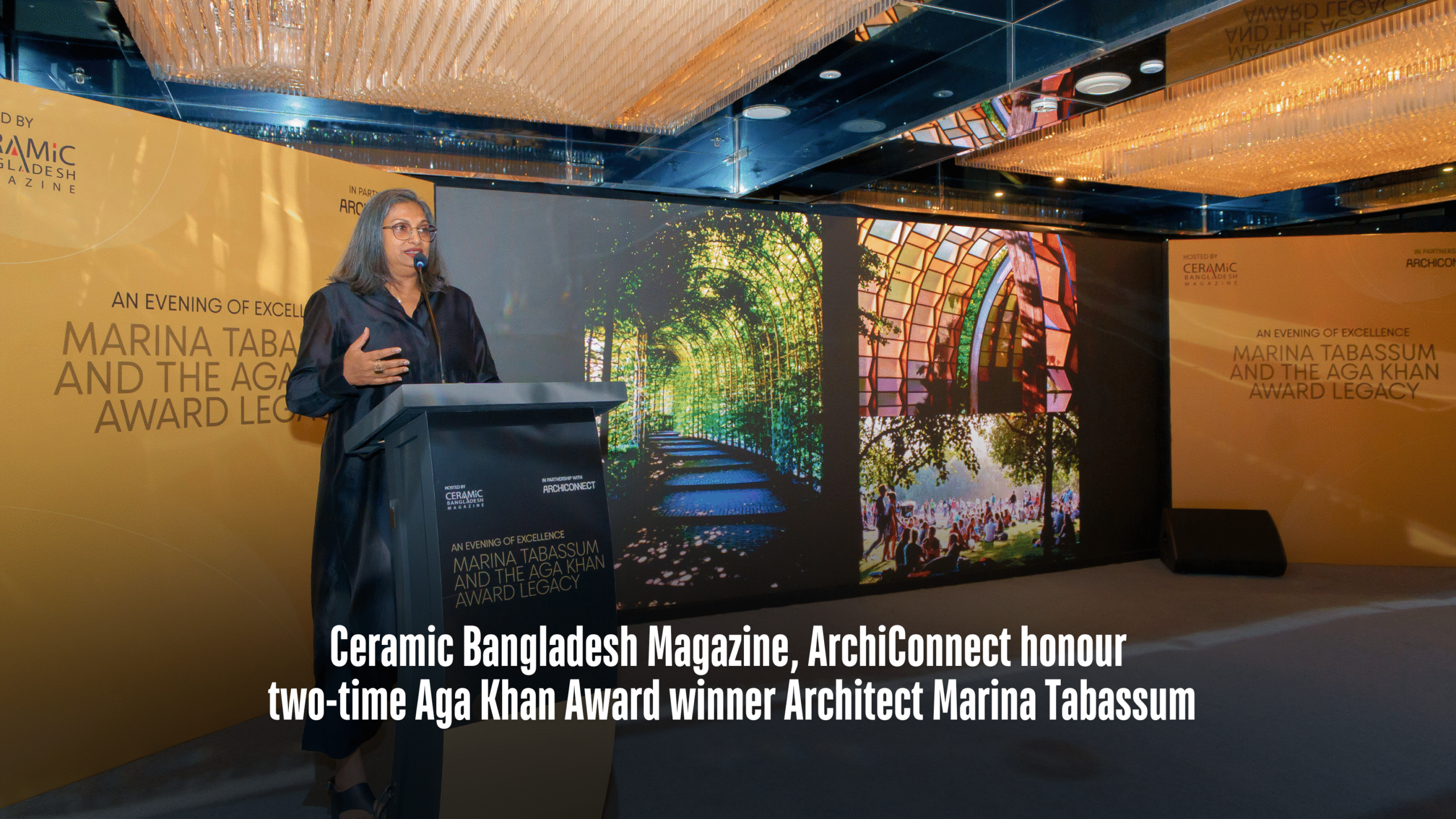
Ceramic Bangladesh Magazine, a publication of the Ceramic Manufacturers and Exporters Association (BCMEA), and ArchiConnect, a buildtech platform, honoured Architect Marina Tabassum on Saturday evening, November 8, 2025, Bangladesh’s only two-time winner of the Aga Khan Award for Architecture—one of the most prestigious awards in the world for architects. At the programme, held at the Renaissance Dhaka Gulshan Hotel, the globally acclaimed architect delivered a keynote speech titled “Between Erosion and Emergence”, highlighting different aspects of the projects that brought her international recognition. Before her keynote, Architect Jalal Ahmed, founder and CEO of ArchiConnect, explained why Marina Tabassum’s achievement should be celebrated and how significant it is. He said the Aga Khan Award for Architecture is considered the “Oscar for Architects,” and winning it twice is a phenomenal success for any architect in the world. Later, Marina presented details of her various projects worldwide. Bait Ur Rouf Mosque, completed in 2012 on the outskirts of Dhaka, was the project that earned her the prestigious Aga Khan Award for Architecture in 2016. “Built with locally sourced brick and devoid of traditional Islamic iconography, it offers a contemplative space where worshippers are bathed in natural light,” she said at the event. “The structure is not just a place of prayer—it’s a refuge for a dense, underserved neighbourhood.” She also shed light on one of her most celebrated recent projects, Khudi Bari, a modular, lightweight shelter designed for ultra-low-income populations. The structure, made of bamboo and corrugated metal, can be assembled quickly and relocated as needed. Earlier, Chief Adviser Professor Muhammad Yunus, in a public congratulatory message, echoed this sentiment: “We fondly recall your first Aga Khan Award in 2016 for the Bait Ur Rouf Mosque in Dhaka, a milestone that celebrated the timeless values of spirituality, community, and simplicity in architecture.” “That recognition marked the rise of a Bangladeshi voice of global significance, and your latest achievement further strengthens that legacy.” In 2025, Khudi Bari earned Tabassum her second Aga Khan Award for Architecture, making her the only Bangladeshi architect to win the honour twice. That same year, she was commissioned to design the Serpentine Pavilion in London—an international recognition of her ability to merge local wisdom with global relevance. Later, at the day, an engaging panel discussion was organised on “Marina Tabassum and the Aga Khan Award Legacy”. The session was moderated by Architect Mahmudul Anwar Riyaad, principal designer and director of DWM4 Architects. Distinguished panelists included Architect Professor Fuad Hassan Mallick, dean of the School of Architecture and Design (SoAD) at BRAC University; Architect Professor Zainab Faruqui Ali, chairperson of the Department of Architecture at BRAC University; and Architect Nahas Ahmed Khalil, principal designer at ARC Architectural Consultants. The event concluded with closing remarks by Moynul Islam, president of BCMEA. “We always look forward to creative minds like architects and the brilliance of Architect Marina Tabassum deserves to be celebrated.” Following the panel discussion, mementos were presented to the distinguished panelists and to Architect Moushumi Ahmed, the gracious host of the evening. The honorees—Architect Marina Tabassum, Architect Jalal Ahmed, and Moynul Islam, President of BCMEA—received exquisite woodprint artworks created by renowned artist Professor Anisuzzaman Anis of the Department of Printmaking, Faculty of Fine Art, University of Dhaka Written by CBM Desk