

Eco-Friendly Design BD
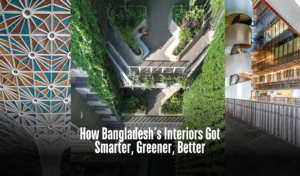
How Bangladesh’s Interiors Got Smarter, Greener, Better
Over the past decades, Bangladesh’s interior sector has undergone a steady evolution. This progressive transformation in design trends and practices is significant across all sectors, including residential, industrial, healthcare, hospitality, retail, and commercial spaces. Rapid urbanisation, economic growth, globalisation, cultural exposure, and growing concern for sustainability are the major forces driving the interior design shift. Changing Residential Interior As urbanisation accelerates, a gradual shift in housing typology has emerged. Traditional single-storey houses and bungalows are being replaced by denser urban structures and micro-apartments, particularly in major cities such as Dhaka and Chittagong. As a result, residential units are now designed with more compact and efficient layouts. To maximise functionality, designers incorporate space-saving solutions, including wall-mounted shelving, built-in storage, and modular furniture. As plots shrink and outdoor gardens become scarce, balconies and terraces are being converted into green oases that help bring nature indoors. In terms of design styles, interior spaces now reflect greater diversity, ranging from minimalist and modern to contemporary and fusion. Collectively, these factors are redefining residential interiors as more functional, sustainable, and visually harmonious. Shift in Commercial Design In the early to mid-20th century, commercial interiors were formal and compartmentalised, with enclosed rooms and long corridors. Materials such as wood and marble were used to convey permanence and formality. By the late 20th century, the rise in corporate culture and global trends led to the emergence of open-plan layouts. Rigid walls began to be replaced by glass partitions that fostered communication and a transparent working environment. From the 2010s onward, corporate interiors started to prioritise sustainability and employee wellbeing. Concepts such as biophilic design and eco-friendly materials, including reclaimed wood and recycled components, are now being incorporated to improve air quality. The Decathlon’s Dhaka office designed by Studio One Zero, is a perfect example of a workspace that blends nature and smart design seamlessly. “What truly distinguishes the office space is its deliberate, sensitive incorporation of natural elements into an urban setting. We wanted the overall design to be meaningful and experiential” ,says Jafor Hoq, chief architect of Studio One Zero. Embracing Tech-led Designs Bangladesh’s industrial interiors—especially in RMG, tanneries, food processing, and other sectors—have drastically changed over the past 50 years. Early factories were built with tight production floors, poor lighting and ventilation, and minimal worker amenities. As industries began to rise, manufacturers moved towards vertical integration (cutting, dyeing/finishing, warehousing, R&D/sample rooms). This initiative introduced a major shift in industrial interiors; however, worker facilities remained basic. The Rana Plaza collapse in 2013 led to a surge of inspections and safety retrofits, resulting in changes to fire safety systems, marked aisles, medical rooms, and improved workstation ergonomics. New industries now increasingly integrate life-safety upgrades (fire doors, fire escape signage), clear zoning, and worker-welfare blocks (cleaner toilets, canteens, and childcare rooms). Energy-efficient LED lighting, water-saving fixtures, and other green building strategies are being adopted. According to the Bangladesh Garment Manufacturers and Exporters Association (BGMEA), the country boasts 258 LEED-certified factories, including 109 Platinum and 133 Gold-rated facilities. Institutional interiors in Bangladesh have also undergone significant transformation, shaped by both local and global design trends in architecture, technology, and educational philosophy. Earlier universities featured classic, colonial-style architecture, such as the University of Dhaka. Over time, university interiors shifted towards creating more flexible and student-centric spaces. Classrooms today are equipped with modern technologies such as multimedia projectors and smartboards. Moreover, charging stations and internet access points are being integrated into common spaces—libraries, lounges, and cafeterias. Sustainable design practices have become one of the most significant considerations over the decades. For example, BRAC University has incorporated biophilic design principles, eco-friendly materials, and energy-efficient systems. The university adopts modern colour schemes and diverse textures, along with more student-friendly amenities that promote collaboration and creativity. Hospitality and Public Spaces Blending Global Aesthetics Early hotels (during the 1960s–1980s) in Bangladesh prioritised functionality over aesthetics, often shaped by a colonial-modern architectural approach. Interior layouts were formal, with minimal ornamentation and durable finishes such as terrazzo floors and simple wooden or rattan furniture. In the 1990s–2000s, with the arrival of international brands, interiors shifted towards a contemporary design approach. Spaces became more refined, introducing upgraded amenities, grand lobbies and ballrooms, and heavy use of imported finishes and materials. A significant example of a luxury hotel is the new Sheraton Dhaka, designed by Volumezero Ltd. It features grand lobbies and banquets, lavish dining venues, and premium materials and finishes. From 2010 onwards, hotel and resort design began to blend local cultural elements with global contemporary styles. This includes the use of local craftsmanship, textiles, motifs, and artwork. Sustainable materials such as bamboo and jute, along with natural textures like wood finishes and earthy plasters, are now extensively used. Public spaces such as airports in the early period focused primarily on practicality and functionality. For example, the old Tejgaon Airport and early Hazrat Shahjalal International Airport (HSIA) featured simple layouts with limited amenities. With gradual modernisation, airport interiors began to prioritise passenger comfort. Duty-free shops, cafés, lounges, and digital flight displays have been incorporated. From the 2010s to the present, design has integrated modern efficiency with local art and aesthetics. Elements include modern amenities (digital signage, self-scanners), imported materials, and sustainable finishes. A prominent example is HSIA Terminal 3, designed by architect Rohani Baharin. The design incorporates modern minimalism and local cultural motifs, highlighting clean, light-toned finishes, large open spaces, and high vaulted ceilings with an eye-catching floral geometric motif. Natural lighting is emphasised, reducing dependence on harsh artificial lighting. Another prominent example in the transformation of public transport infrastructure is the new Cox’s Bazar Railway Station, designed by Volumezero Ltd. The transportation hub has evolved from a functional terminal into a high-end passenger experience. “We aimed to depart from the traditional notion of railway stations being merely standard
Read More