Industry Leaders Unite for a Greener Bangladesh
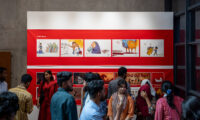
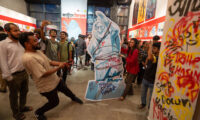
A Call for Sustainable Transformation On January 30, 2025, the Sheraton Hotel in Dhaka hosted “Shaping Bangladesh: Designing Tomorrow, Building Today”, a landmark event organised by Ceramic Bangladesh Magazine. It brought together leaders from construction, real estate, and ceramics to champion sustainability and innovation in response to environmental challenges. Thought Leadership for a Greener Future As part of the series “Innovating for a Sustainable Future II”, the multi-panel format featured experts from ceramics, cement, and real estate. Moderated by Dr. Amir Ahmed of Daffodil International University, the panels included Muhammad Badrul Hassan (BBS Cables), Salehin Musfique Sadaf (GPH Ispat), Architect Faysal Ahmed (Concord Real Estate), AKM Ziaul Islam (Magna Ceramic), Mohammad Khorshed Alam (Akij Bashir Group), Asadul Haque Sufyani (Metro Cement), and Babor Hossain (Khadim Ceramics). Key Recommendations for Sustainability Panelists urged greater investment in R&D to reduce reliance on imports and foster local innovation. They called for collaboration across sectors to promote recycled materials and eco-friendly components. Suggestions included using fly ash and slag in cement, adopting hybrid or electric furnaces, and implementing energy-efficient manufacturing. Smart Materials and Policy Reform Experts advocated for smart glass technologies—low-E, solar, and self-cleaning—to boost building efficiency. They also recommended policy reforms to protect local manufacturers from zero-tariff imports and emphasized the need for government-run clay mines to secure raw materials for ceramic production. Bangladesh’s Tile Industry Comes of Age AKM Ziaul Islam highlighted the tile industry’s evolution since 1984. “We started with 100 mm tiles in one color. Now, we export to the USA,” he said. Despite high production costs, innovation has improved working conditions and sustainability, making the industry globally competitive. Real Estate and Domestic Innovation Architect Faysal Ahmed reflected on the sector’s overreliance on imports between 2000 and 2015. He stressed the importance of collaboration among architects, engineers, and academics to develop sustainable materials locally and reduce dependency on foreign technologies. Material Optimization for Environmental Impact Salehin Musfique Sadaf emphasized that optimized material use can reduce emissions and speed up construction. “Using 15,000 kg of cement instead of 20,000 kg without compromising strength means real sustainability,” he explained. Rethinking Cement and Energy Asadul Haque Sufyani discussed the carbon footprint of cement production and promoted fly ash and slag as eco-friendly alternatives. He stressed the need for affordable, sustainable materials and energy-efficient technologies. Energy Crisis and the Future of Glass Mohammad Khorshed Alam raised concerns about gas shortages affecting glass furnaces. He urged investment in hybrid furnaces and advanced technologies and called on architects to incorporate more locally produced glass to avoid overcapacity and unsold stock. Ceramic Bricks: A Smarter, Greener Choice Babor Hossain showcased ceramic bricks’ advantages over handmade red bricks—lower water absorption, higher strength, and reduced structural load. “They were used in national landmarks and can cut construction costs by 13 percent,” he said, advocating for government-run clay mines to sustain innovation. A Unified Path Forward The event concluded with a call for synergy among policymakers, industry, and academia. With rising climate risks and infrastructure demands, embracing innovation is not just strategic—it’s essential. Photo: Courtesy
Urban October 2025: IAB Organises Daylong Event, Three-Day Exhibition
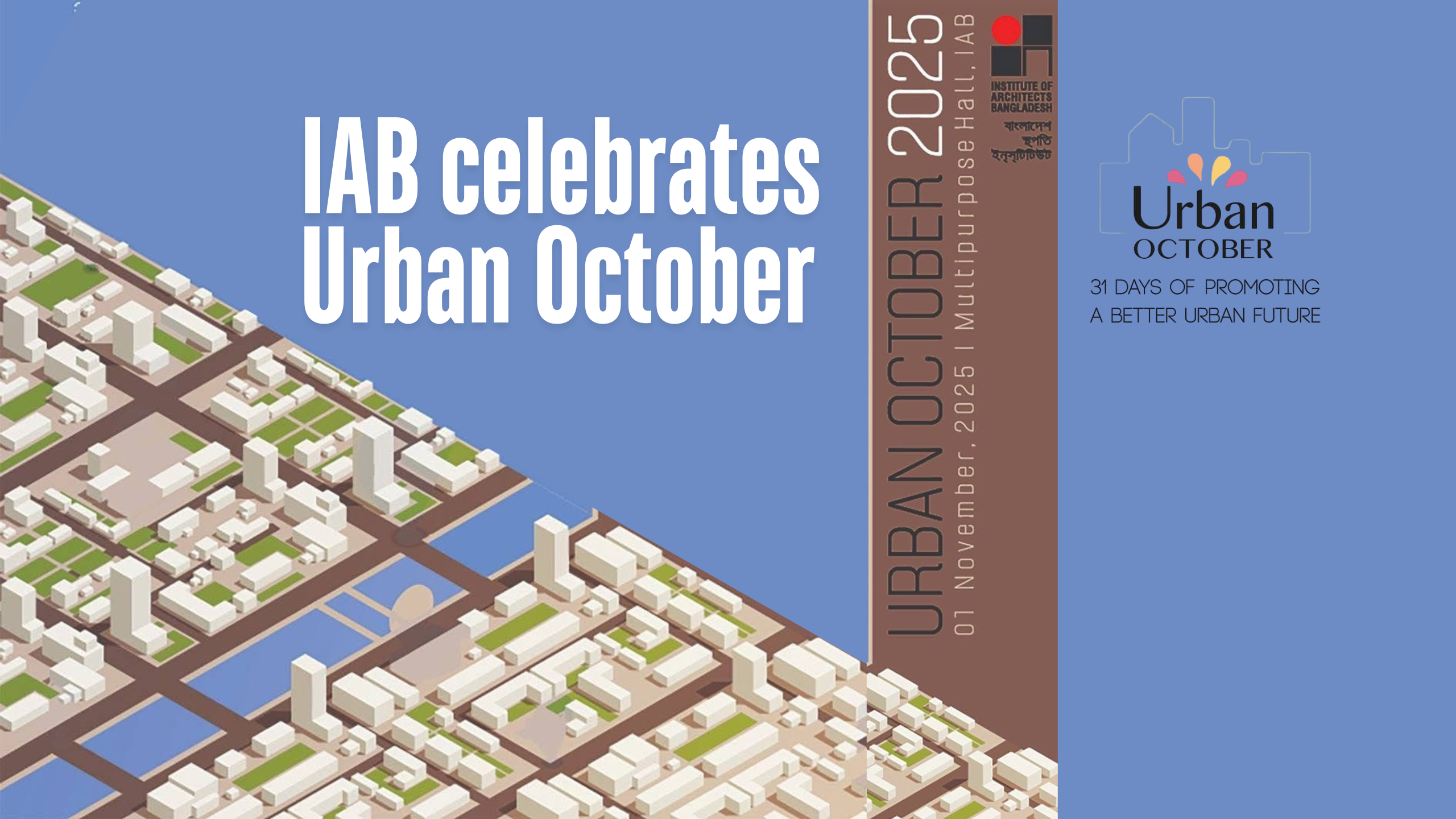
The Institute of Architects Bangladesh (IAB) on November marked Urban October 2025 with a day-long celebration at its Multipurpose Hall, bringing together students, professionals, and policymakers to reflect on the future of urban design in Bangladesh. Timed to coincide with World Architecture Day, World Habitat Day, and World Cities Day, the event began at 10:30 am with the opening of a three-day exhibition showcasing student urban design studio projects from architecture departments across IAB-accredited universities. Participating institutions include Bangladesh University of Engineering and Technology (BUET), Bangladesh University (BU), BRAC University (BRACU), Chittagong University of Engineering and Technology (CUET), North South University (NSU), American International University-Bangladesh (AIUB), Ahsanullah University of Science and Technology (AUST), Khulna University (KU), Shahjalal University of Science and Technology (SUST), Dhaka University of Engineering and Technology (DUET), Daffodil Institute of IT (DIT), Southeast University (SEU), Stamford University, State University, and the University of Asia Pacific (UAP). There was a roundtable discussion on “Shaping Cities: The Role and Future of the Urban Design Profession in Bangladesh” led by academicians. The exhibition offers a glimpse into the next generation’s vision for Bangladesh’s urban future, with models and visualisations of cityscapes, transport corridors, and public spaces. At 4:00 pm, the main programme commenced with a roundtable discussion titled “Interference to Planning: DAP”, led by Team Environment & Urbanisation from IAB’s 26th Executive Council. The session addressed concerns surrounding the Detailed Area Plan (DAP) and its implications for sustainable development, zoning, and citizen engagement. The theme for this year’s World Cities Day — “People-centred Smart Cities” —guided the evening’s discussions. A documentary presentation highlighted month-long Urban October activities, including editorial seminars and conventions. Experts and stakeholders then joined a panel discussion, followed by speeches from the chairperson, the chief guest. The event concluded with a vote of thanks. Held under the banner of Urban October, the celebration reaffirms IAB’s commitment to shaping inclusive, resilient, and well-planned cities. As Bangladesh continues to urbanise rapidly, today’s gathering serves as both a showcase and a call to action — urging architects to lead with vision, integrity, and public purpose. The World Cities Day 2025 event ended with the distribution of certificates. Programme Schedule: Location: IAB Office Date: November 1, 2025 Time: Exhibition: 10:30 am Main programme: 4:00 pm Written by Nibir Ayaan
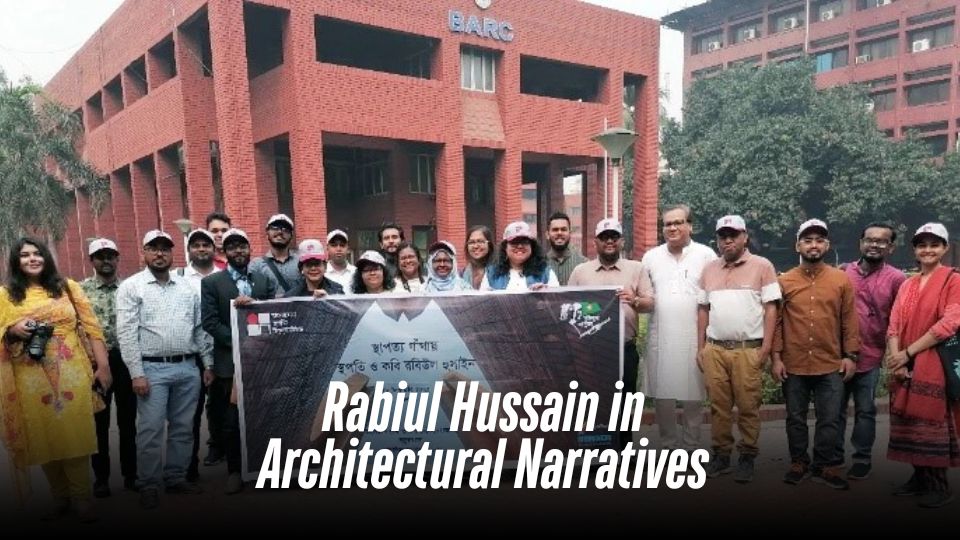
Rabiul Hussain in Architectural Narratives
On February 28, 2025 Bangladesh Institute of Architects (IAB) and the Bangladesh Liberation War Museum organized a day-long program to tribute architect Rabiul Hussain through visiting 3 of his projects- Bangladesh Agricultural Research Council (BARC), Jalladkhana Killing Ground and Jahangirnagar University. and taking a vow to protect the diversified works of the architect. Architect Rabiul Hussain (January 31, 1943 – November 26, 2019) was a prominent Bangladeshi architect, poet, art critic, short story writer, essayist, and cultural activist. A person of multifaceted talent, honored by the Government of Bangladesh with the Ekushey Padak for his contributions to language and literature in 2018, received the Bangla Academy Literary Award for his contributions to poetry in 2009, and the Bangladesh Institute of Architects (IAB) awarded him the Gold Medal for his outstanding contribution to architecture in 2016. He served four times as the President of the Bangladesh Institute of Architects, Vice-Chairman of the Architects Regional Council of Asia (ARCASIA), Vice-President of the Commonwealth Association of Architects, and President of the South Asian Association for Regional Cooperation of Architects. In addition, he was a trustee of the Liberation War Museum, an executive member of the 1971 Ghatok Dalal Nirmul Committee (Committee for Elimination of Martyrs’ Assassination), and made significant contributions to the preservation of the memories of the Independent War of Bangladesh. Although he was born in the village of Ratidanga in Shailkupa Upazila, Jhenaidah District, he completed his secondary and higher secondary education in Kushtia District. Later, in 1968, he earned his Bachelor degree in architecture from the then East Pakistan University of Engineering (now Bangladesh University of Engineering and Technology). After obtaining the graduation, he began his professional career as an architect working with architect Mazharul Islam and later joined Shahidullah Associates. Alongside his architectural practice, he also maintained a strong passion for writing. Throughout his career, he served as a life member of the Bangla Academy, and was involved in various organizations, including the Central Kachi-Kachhar Mela (a children’s and youth organization), the National Poetry Council, the Bangabandhu Sheikh Mujibur Rahman Memorial Museum, the International Film Critic Association of Bangladesh, and the Bangladesh Institute of Architects. Notable buildings designed by him include the Jalladkhana(Execution House), the Bangladesh Agricultural Research Council building, the entrance gate of Dhaka University, the Liberation and Independence Arch, the Jahangirnagar University gate, the Bhashani Hall, the Bangabandhu Hall, the Sheikh Hasina Hall, the Khaleda Zia Hall, the Wazed Mia Science Complex, the auditorium and academic building complex of Chittagong University, and alongside architect Mazharul Islam, the Bangladesh Agricultural Research Institute in Gazipur, Haji Mohammad Danesh Science and Technology University in Dinajpur, and polytechnic institutes in Chittagong and Khulna, among others. Bangladesh Agricultural Research Council (BARC) The Bangladesh Agricultural Research Council (BARC) was established in 1973 with the aim of conducting agricultural research and coordinating various related institutions in Bangladesh. Almost a decade after its founding, in 1982, architect Rabiul Hussain designed its current building. The design process, which began in 1978, spanned nearly four years. In a remarkable way, he crafted a unique architectural design using red brick masonry that harmonized with Bangladesh’s climate, nature, and way of life. This building is a symbol of post-independence architecture, reflecting a search for an architectural style; that is free from the burden of colonization in a newly liberated land. Each detail of the building echoes the same vision. The regional architectural influence of Maestro Mazharul Islam, the pioneer of Bangladesh’s regional architecture, is evident in the design, which he was fortunate to experience starting from his third year of architectural education. The building, located on a site shaped like the letter ‘L’ in the English alphabet, is easily noticeable among surrounding roads and structures. It stands at the junction of Airport Road and Khamar Bari Road, near Farmgate and Bijoy Sarani. The design symbolizes various aspects of aesthetic gravity, marking an early effort in the evolution of post-independence Bangladeshi architecture and the search for a Bengali “identity” in the country’s-built environment. The location of the building, near the capital’s main international airport at Tejgaon, limited the building’s height to four floors. The rectangular building, measuring 223 feet in length and 63 feet in width, has a total built-up area of 32,700 square feet. It is aligned along the east-west axis and is equipped with optimal provisions for cross-ventilation and prevailing south winds. The three-story building is vertically divided into three functional zones. The first floor is allocated for administrative offices; the second floor houses the executive branch. The third floor features a 7,500-square-foot conference room with seating for 280 people at its center, along with a 1,350-square-foot library and a meeting room. The first and second floors are organized along a double-loaded corridor, with two staircases at the eastern and western ends of the building. In harmony with local traditions, the roof was projected to protect the building from torrential rain and scorching sun. The BARC building essentially consists of two parts: one is the brick-clad inner shell that spans the main area, while the additional levels moderate the harsh tropical sun and protect the building during the monsoon season. Architect Mazharul Islam’s office- Vastukalabid was a key influence in experimenting with such a critical combination of climate consideration and modernist aesthetics along with that of brick mason for architect Rabiul Hussain and many young architects in the early 1970s. To give an example, his designs, including the National Institute of Public Administration (1964), encouraged a generation of architects to explore “critical regionalism” through a lens that considered climatic aspects in the visual language of architecture. Since stone is rare and fired bricks can be produced in abundance from local clay, architects saw bricks as an unprecedented symbolic representation of the delta and its culture. Representing the soil of the riverine country, bricks were the purest or most organic building material believed by the Bangladeshi architects. The “poetry” of bricks is hard to miss in the concept and construction of the BARC headquarters building. Also, the influence of