

Rabiul Hussain in Architectural Narratives
On February 28, 2025 Bangladesh Institute of Architects (IAB) and the Bangladesh Liberation War Museum organized a day-long program to tribute architect Rabiul Hussain through visiting 3 of his projects- Bangladesh Agricultural Research Council (BARC), Jalladkhana Killing Ground and Jahangirnagar University. and taking a vow to protect the diversified works of the architect. Architect Rabiul Hussain (January 31, 1943 – November 26, 2019) was a prominent Bangladeshi architect, poet, art critic, short story writer, essayist, and cultural activist. A person of multifaceted talent, honored by the Government of Bangladesh with the Ekushey Padak for his contributions to language and literature in 2018, received the Bangla Academy Literary Award for his contributions to poetry in 2009, and the Bangladesh Institute of Architects (IAB) awarded him the Gold Medal for his outstanding contribution to architecture in 2016. He served four times as the President of the Bangladesh Institute of Architects, Vice-Chairman of the Architects Regional Council of Asia (ARCASIA), Vice-President of the Commonwealth Association of Architects, and President of the South Asian Association for Regional Cooperation of Architects. In addition, he was a trustee of the Liberation War Museum, an executive member of the 1971 Ghatok Dalal Nirmul Committee (Committee for Elimination of Martyrs’ Assassination), and made significant contributions to the preservation of the memories of the Independent War of Bangladesh. Although he was born in the village of Ratidanga in Shailkupa Upazila, Jhenaidah District, he completed his secondary and higher secondary education in Kushtia District. Later, in 1968, he earned his Bachelor degree in architecture from the then East Pakistan University of Engineering (now Bangladesh University of Engineering and Technology). After obtaining the graduation, he began his professional career as an architect working with architect Mazharul Islam and later joined Shahidullah Associates. Alongside his architectural practice, he also maintained a strong passion for writing. Throughout his career, he served as a life member of the Bangla Academy, and was involved in various organizations, including the Central Kachi-Kachhar Mela (a children’s and youth organization), the National Poetry Council, the Bangabandhu Sheikh Mujibur Rahman Memorial Museum, the International Film Critic Association of Bangladesh, and the Bangladesh Institute of Architects. Notable buildings designed by him include the Jalladkhana(Execution House), the Bangladesh Agricultural Research Council building, the entrance gate of Dhaka University, the Liberation and Independence Arch, the Jahangirnagar University gate, the Bhashani Hall, the Bangabandhu Hall, the Sheikh Hasina Hall, the Khaleda Zia Hall, the Wazed Mia Science Complex, the auditorium and academic building complex of Chittagong University, and alongside architect Mazharul Islam, the Bangladesh Agricultural Research Institute in Gazipur, Haji Mohammad Danesh Science and Technology University in Dinajpur, and polytechnic institutes in Chittagong and Khulna, among others. Bangladesh Agricultural Research Council (BARC) The Bangladesh Agricultural Research Council (BARC) was established in 1973 with the aim of conducting agricultural research and coordinating various related institutions in Bangladesh. Almost a decade after its founding, in 1982, architect Rabiul Hussain designed its current building. The design process, which began in 1978, spanned nearly four years. In a remarkable way, he crafted a unique architectural design using red brick masonry that harmonized with Bangladesh’s climate, nature, and way of life. This building is a symbol of post-independence architecture, reflecting a search for an architectural style; that is free from the burden of colonization in a newly liberated land. Each detail of the building echoes the same vision. The regional architectural influence of Maestro Mazharul Islam, the pioneer of Bangladesh’s regional architecture, is evident in the design, which he was fortunate to experience starting from his third year of architectural education. The building, located on a site shaped like the letter ‘L’ in the English alphabet, is easily noticeable among surrounding roads and structures. It stands at the junction of Airport Road and Khamar Bari Road, near Farmgate and Bijoy Sarani. The design symbolizes various aspects of aesthetic gravity, marking an early effort in the evolution of post-independence Bangladeshi architecture and the search for a Bengali “identity” in the country’s-built environment. The location of the building, near the capital’s main international airport at Tejgaon, limited the building’s height to four floors. The rectangular building, measuring 223 feet in length and 63 feet in width, has a total built-up area of 32,700 square feet. It is aligned along the east-west axis and is equipped with optimal provisions for cross-ventilation and prevailing south winds. The three-story building is vertically divided into three functional zones. The first floor is allocated for administrative offices; the second floor houses the executive branch. The third floor features a 7,500-square-foot conference room with seating for 280 people at its center, along with a 1,350-square-foot library and a meeting room. The first and second floors are organized along a double-loaded corridor, with two staircases at the eastern and western ends of the building. In harmony with local traditions, the roof was projected to protect the building from torrential rain and scorching sun. The BARC building essentially consists of two parts: one is the brick-clad inner shell that spans the main area, while the additional levels moderate the harsh tropical sun and protect the building during the monsoon season. Architect Mazharul Islam’s office- Vastukalabid was a key influence in experimenting with such a critical combination of climate consideration and modernist aesthetics along with that of brick mason for architect Rabiul Hussain and many young architects in the early 1970s. To give an example, his designs, including the National Institute of Public Administration (1964), encouraged a generation of architects to explore “critical regionalism” through a lens that considered climatic aspects in the visual language of architecture. Since stone is rare and fired bricks can be produced in abundance from local clay, architects saw bricks as an unprecedented symbolic representation of the delta and its culture. Representing the soil of the riverine country, bricks were the purest or most organic building material believed by the Bangladeshi architects. The “poetry” of bricks is hard to miss in the concept and construction of the BARC headquarters building. Also, the influence of
Kromosho Beyond ‘Belonging’
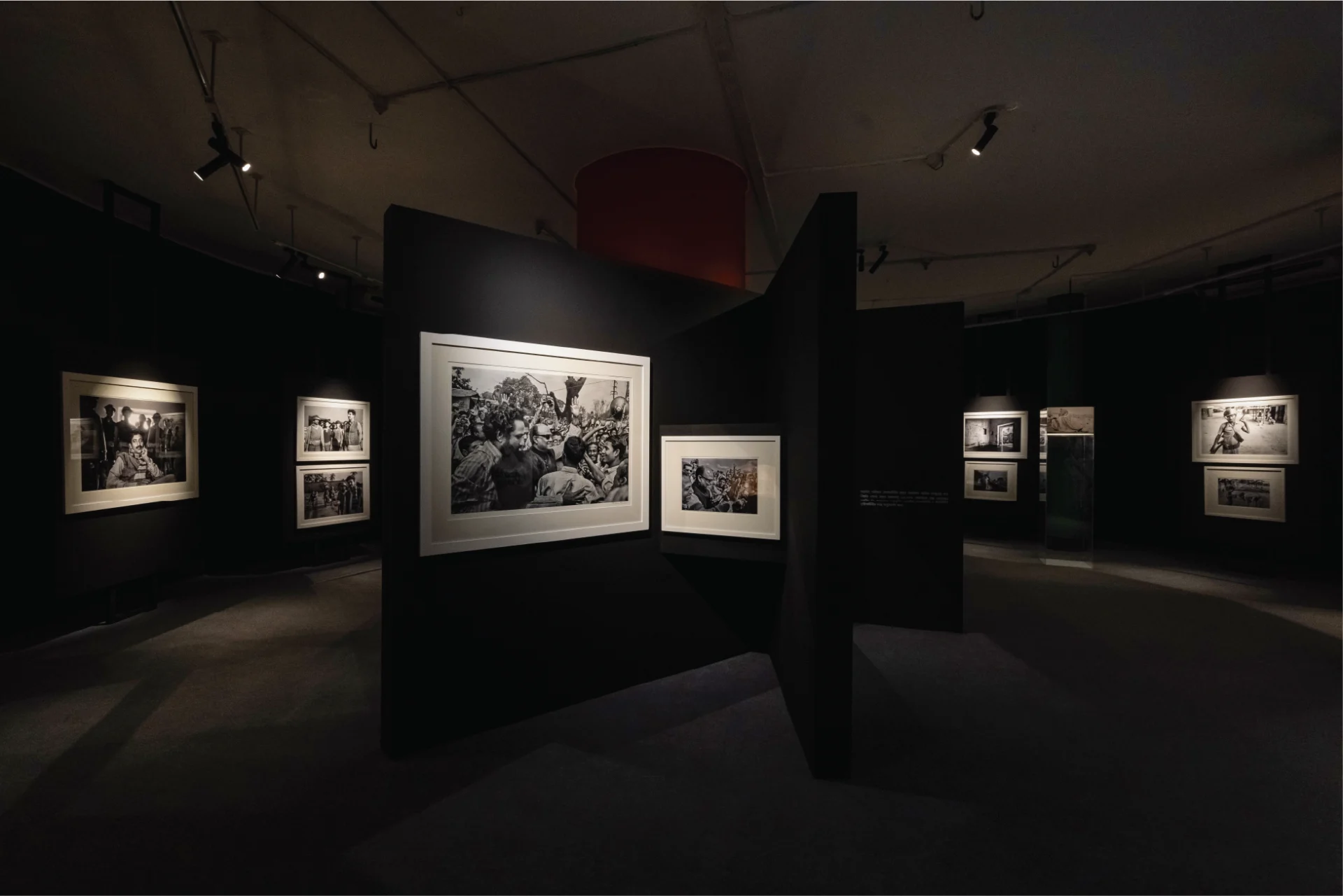
In the mid-2000s, a young- Munem Wasif began exploring the hidden corridors of Old Dhaka alongside his trusty, timeworn companion, Zenit—a mechanical relic from the Soviet era. This journey eventually culminated in his 2012 photographic masterpiece Belonging, a work that revolutionized visual storytelling in Bangladesh’s art scene. Much like the dark, ever-flowing waters of the Buriganga that have witnessed Dhaka’s transformation, Wasif’s artistic journey has traversed many phases—each urging audiences to look beyond the surface. From `Seeds Shall Set Us Free’ to `Collapse’, his work continuously invites deeper reflection, all while retaining an unbreakable bond with Old Dhaka. After nearly 16 years, Munem Wasif returns to Dhaka with a solo exhibition titled `Kromosho’, now on display at Bengal Shilpalay in the capital. The show, which runs until May 31, 2025, features contributions from curatorial advisor Tanzim Wahab, project assistant Iftekhar Hassan, and architectural designer Dehsar Works, and is open to everyone. Reflecting on his previous work, Wasif explained, “I felt something was lacking when Belonging was released. It merely touched upon the surface of the people and their celebrations—I couldn’t capture the core of their daily lives, the very ‘life’ of Puran Dhaka. That realization gave birth to Kheya’l. This exhibition is a testament to my transformation over the past two decades.” The opening at Bengal Shilpalay buzzed with energy as art enthusiasts gathered to witness what promises to be one of the most memorable exhibitions in recent memory. Kromosho unfolds in three movements: it begins with Wasif’s ethereal black-and-white photographs from the Belonging era, which converse with his fresh, vibrant color works from Stereo. This juxtaposition creates a dynamic tension between past and present, memory and reality. In Kheyal, a cinematic meditation captures the pulsing rhythm of Old Dhaka, while the installations Shamanno and Paper Negative blend documentation with imagination, challenging our perceptions of what is real versus what is remembered. Critically, Old Dhaka may seem like a ticking time bomb—overcrowded, decaying, and a bitter relic of collective neglect. Yet, Wasif’s work reveals the hidden vitality amid this chaos, unearthing a poetry rarely seen by the casual observer. Kromosho does more than display images of a place; it captures its very essence. The exhibition serves as a mirror, prompting us to consider what we preserve and what we forsake in our relentless march toward modernity. In an age of rapid urbanization and cultural amnesia, Wasif’s work stands as both an archive and an elegy—an enduring reminder that some stories transcend what can be captured by cameras or words. To fully appreciate its depth, one must experience it both in person and with an open, reflective heart. As visitors wander through the gallery, they are invited not only to observe but also to introspect. In this way, Kromosho transcends the role of a mere art exhibition—it becomes a conversation, a homecoming, and ultimately, a call to bear witness. Written by Shahbaz Nahian
Three-day Global Sourcing Expo 2025 opens in Dhaka
The Global Sourcing Expo 2025 – Dhaka has opened at the Bangladesh-China Friendship Exhibition Centre in Purbachal, bringing together exporters, buyers and trade bodies from across the world in a major push to diversify Bangladesh’s export markets. Jointly organised by the Export Promotion Bureau (EPB) and the commerce ministry, the three-day event is being billed as a strategic international platform showcasing Bangladesh’s evolution from a global apparel powerhouse to a diversified export hub. The expo features products from eight major sectors: readymade garments, leather and leather goods, jute and jute products, agricultural goods, plastics and kitchenware, home décor and furniture, pharmaceuticals, and ICT. More than 100 firms are taking part, including multinational companies, wholesalers and supply-chain representatives. Buyers and sourcing organisations from Afghanistan, China, Iran, Japan, Myanmar, Pakistan, Singapore, Sri Lanka, Thailand, the UAE, the US and several other countries are attending business-to-business meetings and negotiating potential contracts. The fair houses 200 stalls and includes 12 thematic seminars, fashion shows, product demonstrations, and both online and offline networking sessions. Organisers say the event is designed to connect local businesses with global buyers, trade bodies and new market opportunities to accelerate export growth and diversification. Commerce Adviser Sk Bashir Uddin, who inaugurated the expo, said Bangladesh must accelerate diversification, strengthen competitiveness and adopt forward-looking trade policies as it prepares to graduate from the group of least developed countries (LDCs). “To navigate this transition successfully, we must accelerate diversification, improve competitiveness, and adopt forward-looking trade policies,” he said. He added that while graduation is a major achievement, it will gradually reduce the preferential market access and duty benefits Bangladesh currently enjoys. At a seminar on the sidelines of the expo, Mohammad Hatem, president of the Bangladesh Knitwear Manufacturers and Exporters Association, said foreign involvement in port operations could improve efficiency. He also called for suspension of the amended labour law until a newly elected government is in place, arguing that the current changes are neither industry- nor worker-friendly. In another session, Inamul Haq Khan, senior vice-president of the Bangladesh Garment Manufacturers and Exporters Association, stressed the need for easier access to green financing, greater support from brands through knowledge sharing and technology transfer, and targeted interventions for SMEs. He urged wider regional inclusion so that areas such as North Bengal, Sylhet and Chattogram can benefit alongside Dhaka-centric clusters. Khan also called on the government to amplify the industry’s success stories through Bangladesh’s embassies and high commissions abroad, showcasing achievements on the global stage. The expo is being positioned as a vital opportunity for companies aiming to expand exports, launch new product lines or strengthen global brand visibility. With strong government backing for trade and investment, it reflects Bangladesh’s push for product and market diversification at a time when the country is seeking to secure its place in global markets beyond garments. Speakers at the event included Lutfey Siddiqi, special envoy for international affairs to the chief adviser; Mohammad Hasan Arif, EPB vice chairman; Mahbubur Rahman, commerce secretary; and Md Abdur Rahim Khan, administrator of the Federation of Bangladesh Chambers of Commerce and Industry (FBCCI). Organisers say the expo is not only about showcasing products but also about building long-term partnerships. The inclusion of thematic seminars and networking sessions is intended to encourage dialogue on issues ranging from sustainable production and green financing to supply-chain resilience and regional inclusion. The event comes at a critical time for Bangladesh’s economy. As the country prepares for LDC graduation, policymakers and industry leaders are emphasising the need to diversify the export basket, strengthen supply-side capacity and forge new partnerships with international buyers. The expo, they argue, provides a platform to address these challenges while highlighting Bangladesh’s achievements and ambitions. By bringing together stakeholders from across the world, the Global Sourcing Expo 2025 – Dhaka underscores the country’s determination to move beyond its reliance on garments and establish itself as a competitive player in a wider range of industries. Written by Nibir Ayaan